' d='M0 0h21v15H0z'/%3E%3Cpath d='M0 0h21v1H0V0zm0 2h21v1H0V2zm0 2h21v1H0V4zm0 2h21v1H0V6zm0 2h21v1H0V8zm0 2h21v1H0v-1zm0 2h21v1H0v-1zm0 2h21v1H0v-1z' fill='url(%23b)'/%3E%3Cpath fill='url(%23c)' d='M0 0h9v7H0z'/%3E%3Cpath d='M1.5 2a.5.5 0 110-1 .5.5 0 010 1zm2 0a.5.5 0 110-1 .5.5 0 010 1zm2 0a.5.5 0 110-1 .5.5 0 010 1zm2 0a.5.5 0 110-1 .5.5 0 010 1zm-5 1a.5.5 0 110-1 .5.5 0 010 1zm2 0a.5.5 0 110-1 .5.5 0 010 1zm2 0a.5.5 0 110-1 .5.5 0 010 1zm1 1a.5.5 0 110-1 .5.5 0 010 1zm-2 0a.5.5 0 110-1 .5.5 0 010 1zm-2 0a.5.5 0 110-1 .5.5 0 010 1zm-2 0a.5.5 0 110-1 .5.5 0 010 1zm1 1a.5.5 0 110-1 .5.5 0 010 1zm2 0a.5.5 0 110-1 .5.5 0 010 1zm2 0a.5.5 0 110-1 .5.5 0 010 1zm1 1a.5.5 0 110-1 .5.5 0 010 1zm-2 0a.5.5 0 110-1 .5.5 0 010 1zm-2 0a.5.5 0 110-1 .5.5 0 010 1zm-2 0a.5.5 0 110-1 .5.5 0 010 1z' fill='url(%23a)'/%3E%3C/g%3E%3C/svg%3E)
' d='M0 0h21v15H0z'/%3E%3Cpath fill='url(%23b)' d='M0 0h21v15H0z'/%3E%3Cpath d='M13.052 4.737A3.907 3.907 0 0010.75 4C8.679 4 7 5.567 7 7.5S8.679 11 10.75 11c.868 0 1.667-.275 2.302-.737a4.5 4.5 0 110-5.526zm1.214 3.34l-.919 1.113.063-1.442-1.343-.53 1.39-.386.09-1.441.796 1.204 1.398-.361-.898 1.13.775 1.217-1.352-.505z' fill='url(%23a)'/%3E%3C/g%3E%3C/svg%3E)

Join us
Join the adventure!
Sharing the ultra spirit means opening yourself up to ultra friendships.
At Sandras, we believe not only in running, but also in collective creation and empowerment.
Respect for nature, recognition of work, and trust in human beings are our core values.
If you are also a traveller on this path, we would love to have you join us.
The journey is more beautiful with you.
Mount Sandra:
A Cultural Journey from Ancient Legends to the Present Day
1. Mount Sandras in Antiquity
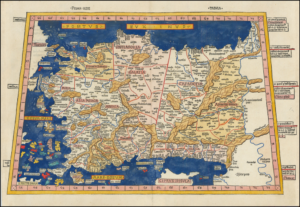
On the “Asia” map drawn by the ancient geographer Ptolemy in the 2nd century, the regions of Caria and Lycia are clearly delineated; Mount Sandras forms part of this ancient geographical landscape. In antiquity, Mount Sandras rose as a significant peak on the border between Caria and Lycia. Known in ancient sources as Tarbelos, the mountain is described as a majestic massif separating the inland parts of Caria from Lycia near the city of Kaunos. Linguistic studies suggest that the name Tarbelos derives from the Luwian root tāru- (“forest, woodland”), indicating that the mountain’s name carried the meaning “wooded mountain.” Indeed, in ancient times the slopes of the mountain were covered with dense forests, supplying timber for shipbuilding to cities such as Kaunos.
Over time, the name Sandras became interwoven with legends layered upon this ancient heritage. According to a local legend, Mount Sandras once quarreled with the opposing Atkuyruksallamaz Mountain. While the rocks hurled by Atkuyruksallamaz failed to reach Sandras, the “cannonballs” thrown by Mount Sandras shattered the peak of its rival. Defeated, the other mountain is said to have declared, “Sen dırazsın” (in local dialect, “You are tall, you are great”), acknowledging Sandras’s supremacy. According to the tale, the name Sandras emerged through the transformation of this phrase. This legend lends a mythological motif to the mountain’s name while narratively emphasizing its status as the highest summit in the region. Although no specific deity or mythological account directly associated with Sandras (Tarbelos) appears in ancient Greek sources, high mountains have long been regarded as sacred throughout Anatolia. It is well known that mountain cults were widespread across different geographies, where peaks were believed to be connected with divine powers. The derivation of Sandras’s ancient name from the Luwian language and the legends that formed around it demonstrate that the mountain has carried both linguistic and cultural heritage from antiquity to the present day.
2. Natural and Geographical Characteristics
Mount Sandras rises at the southwestern end of the Western Taurus mountain range, between Köyceğiz in Muğla Province and Beyağaç in Denizli Province. Its summit reaches an elevation of 2,295 meters and is also known as Çiçek Baba Peak, a name associated with local beliefs. Overlooking the surrounding terrain from its commanding height, the mountain represents a significant geographical and ecological landmark. Sandras is home to extensive plateaus and crater lakes along its slopes. The most renowned of these are Kartal Lake near the summit, as well as Karagöl and Topuklu Plateau on the mountainsides. Kartal Lake is a small crater lake located on one of Sandras’s high plateaus and, beyond its natural beauty, serves as a focal point for local belief rituals. Karagöl, named after its deep and dark waters, is another lake surrounded by pine forests. Topuklu Plateau, with its wide meadows at the foot of Sandras, has long been a summer settlement for the traditional nomadic Yörük way of life. For centuries, Yörük clans have set up camps here, grazed their goat herds, and lived in close harmony with the mountain. Today, local people still use Topuklu Plateau during the summer months, and in recent years the area has also hosted astronomical observation events thanks to its minimal light pollution, attracting skywatchers as one of Turkey’s darkest regions.
On the mountain’s peaks, which resemble volcanic craters,
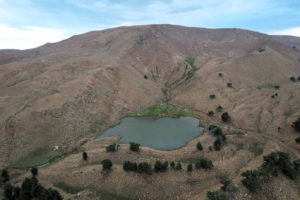
water accumulates to form lakes, and campers often stay in these areas during the summer months. The natural structure of the mountain is exceptionally rich due to its location at the intersection of Mediterranean and Aegean climate zones. The slopes of Sandras are covered with black pine forests (Pinus nigra) and endemic sweetgum trees (Liquidambar orientalis). In 1995, this unique ecosystem was designated a first-degree natural protected area. The 1,309-hectare area surrounding Kartal Lake is also classified as a “nature conservation area,” hosting a monumental forest composed of black pine trees aged between 250 and 800 years. With nearly 750 plant taxa and nine endemic plant species found nowhere else, Mount Sandras ranks among Turkey’s most significant regions in terms of biodiversity. Consequently, it lies within the globally recognized “Mediterranean Hotspot” bioregion and is considered a priority area for conservation. Wildlife diversity is similarly remarkable: endemic bird species inhabit the black pine forests, while wolves, caracals, and brown bears can be encountered in the mountain’s remote and quiet wilderness.
Throughout history, the natural resources of Mount Sandras have been used wisely by local communities. In antiquity, its dense forests supplied timber for shipbuilding to port cities such as Kaunos, with cedar and pine trees from the Ağla region transported downstream to urban centers. In his work Geographika, Strabo notes that Kaunos had shipyards and that timber from the Sandras forests was conveyed via rivers. Today, the mountain’s water resources continue to sustain life: streams such as Gökçay and Karaçay rise from its slopes, feeding the Dalaman River and nourishing Köyceğiz Lake and its surroundings. During snowy winters, Sandras is blanketed in white, and in spring the melting snow replenishes these waterways, providing vital irrigation for agriculture in the plains while forming countless small ponds and streams along the foothills. This natural cycle has always shaped the relationship between the local people and the mountain; Mount Sandras has long been revered as a source of life.
3. Mount Sandras Today
Today, Mount Sandras stands as a place where natural heritage and living cultural values converge. In particular, Yörük culture remains vibrant on the mountain’s slopes. For the Yörüks who have migrated seasonally across these lands for centuries, Sandras is not merely a geographical feature but a homeland and a center of belief inherited from their ancestors. With the arrival of spring, Yörük families load their black tents, herds, and belongings and ascend to the cool highlands of Sandras; in autumn, they return to their winter quarters. Within this cycle of seasonal migration, Sandras provides both shelter and abundance. “This mountain is not empty,” local people say; every slope, every tree, and every spring whispers ancestral stories to them. Indeed, the words of Ali Kanat from the village of Karaçam—“With Sandras, one forms not only a physical but also an inner bond”—eloquently express the mountain’s place in the spiritual world of the local population.
For those living in the surrounding villages, Mount Sandras has been deeply internalized. It is not a distant backdrop to their lives but an integral part of them. Some Yörüks even prefer to live year-round in the highlands of Sandras rather than descend to the plains. Muharrem Kırmızı, a man over seventy from the village of Sazak, states, “I live in this hut throughout summer and winter; if I went down to the flatlands, I wouldn’t last a day,” illustrating the profound attachment people feel toward the mountain. This strong bond also reflects the ethical relationship the Yörüks maintain with nature: benefiting from it without causing harm, giving thanks for every blessing, and sharing what is received. For instance, in Yörük belief, the first milk of a goat after giving birth is not consumed but left for the kids, a tradition rooted in respect for nature and fertility. The Mahya Festivals held annually on the slopes of Sandras are another manifestation of this worldview. At the end of August, one week before Eren Day, villagers gather on Ağla Plateau, cooking large cauldrons of food collectively, offering sacrifices, and sharing meals in a spirit of gratitude and solidarity. This festival, sustained through communal effort, embodies the tradition of sharing nature’s gifts and supporting one another.
Beyond its traditional culture, Mount Sandras has also become a favored destination for nature lovers and adventure enthusiasts. Marked hiking trails and ultra-marathon routes around the mountain attract athletes and travelers from across Turkey. In recent years, the Sandras Ultra Trail race has been organized along the mountain’s challenging paths, testing participants’ endurance amid breathtaking landscapes. Topuklu Plateau now hosts not only Yörük tents but also campers and stargazers. At night, far from city lights, the Milky Way appears in all its splendor, and sky observation festivals are held each summer to celebrate this unique experience. All these activities are pursued within a framework of sustainable tourism that respects and seeks to preserve the mountain’s natural environment. Largely untouched by uncontrolled development and mass tourism, Sandras has managed to remain one of Turkey’s cleanest and most pristine mountain regions. Locals often remark that “there are still canyons and trails that have never seen wheeled vehicles,” a statement borne out by the sparse settlements visible around Sandras. Together, local communities and authorities continue to work to protect the mountain’s ecosystem and carry its traditional way of life into the future as part of a sustainable cultural heritage.
4. The Figure of Çiçek Baba
When speaking of the spiritual identity of Mount Sandras, the first figure that comes to mind is undoubtedly Çiçek Baba, the revered saint. According to local belief, Çiçek Baba was one of the spiritual figures who came to Anatolia from the region of Khorasan and settled on the summit of this mountain centuries ago. Legend has it that seventy-two dervishes set out from Central Asia and cast their staffs across the world; each would continue his spiritual guidance where his staff fell. The staffs of five saints landed on the summits of five great mountains in this region: Atkuyruksallamaz, Şimşir, Ölemez, Aygır, and Sandras. The staff that fell on the summit of Sandras belonged to Çiçek Baba. The saint eventually arrived there, found his staff, and made this peak his dwelling. From that day on, the highest point of Mount Sandras began to be known by the name of Çiçek Baba. Among the local people, the term “Çiçekbaba Mountain” is also commonly used, and some sources even refer to the main summit at 2,295 meters as Çiçekbaba Peak.
There are two different interpretations regarding the origin of Çiçek Baba’s name. Some say he was given this epithet because of his love for flowers, while others claim that he was known by this name due to the marks left on his face by smallpox (çiçek hastalığı) in his youth. In any case, the symbol of the “flower” evokes the image of a gentle and nature-friendly saint, securing him a place in the hearts of the people.
Although the exact period in which Çiçek Baba lived is unknown, local belief holds that he came to these lands during the early centuries when Anatolia was becoming a Turkish homeland, approximately around the 13th century. According to legend, Çiçek Baba fought bravely alongside his companions against enemies in the region and was eventually martyred during a raid. He and his companions were buried together on the mountain’s summit. For this reason, it is said that the Çiçek Baba Shrine located at the peak has the form of an elongated grave, as it actually contains multiple saints. This is why the enormous grave is popularly referred to as “the resting place of saints.” The tomb measures approximately 34 meters in length and 3 meters in width; this stone-bordered area inspires both admiration and reverence among visitors. For centuries, the local population has regarded Çiçek Baba as a holy figure, sought his intercession, and preserved his memory.
Every year at the end of August,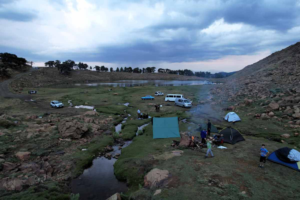
the Çiçek Baba Commemoration (Eren Day) Festivals are held around Kartal Lake on Mount Sandras. Local people and visitors set up camps, and through night-long fires, sacrificial offerings, and prayers, the mountaintop is transformed into an open-air place of worship. This ancient festival represents one of the rare examples in Anatolia where mountain cults and saintly traditions intertwine. One day before the festival, locals set out toward the summit from two directions: those coming from the Muğla–Köyceğiz side reach the shrine via Ağla Plateau, either on foot or by vehicle, while those arriving from the Denizli–Beyağaç side camp by Kartal Lake and spend the night there. In the past, before modern technology, people would set out days in advance with horses and camels, staying overnight along mountain paths before reaching the summit. Although today stabilized mountain roads allow access by vehicle within a few hours, many still choose to follow their ancestors’ path by making the traditional “saint’s walk” on foot. After midnight, during the blessed hours connecting Thursday to Friday, hundreds gather at the grave of Çiçek Baba on the mountain’s peak.
The rituals of Eren Day are rich both emotionally and visually. Before dawn, the gathered crowd walks barefoot three times around the Çiçek Baba Shrine; with each circuit, colorful cloth strips are tied to the stones at the head and foot of the grave, and wishes are made. Some pray for the healing of their children, others for rain for their fields, and others for peace in their country. Wheat grains brought along are scattered over the grave, and small children’s socks are left there as symbols of fertility and protection. According to tradition, many visitors also take a small amount of soil or a stone from the grave, wrap it in a cloth, and carry it home, believing it brings good fortune and represents abundance. Locals pass down the saying, “Soil taken from the saint’s grave is scattered over fields to bring fertility; a stone taken home brings peace.”
After prayers and wishes, vows are fulfilled and sacrificial offerings begin. Those attending Eren Day usually bring a goat or kid as a sacrifice. Before being slaughtered, the animals are carried three times around the shrine on the shoulders of their owners, symbolically presenting the intention to the saint. The sacrifices are then performed according to custom. Interestingly, an ancient tradition is preserved here: rather than dividing the sacrificial meat into portions, it is roasted whole on skewers. Elders explain, “Cooking the offering whole ensures that our prayer and intention are accepted in their entirety,” a practice rooted in pre-Islamic shamanistic rituals of wholeness. As the cooked meat is shared at communal ground tables, everyone contributes a portion from their own table to a large common table, ensuring that those unable to attend the mountain are not excluded from the blessing. In earlier times, shares were always set aside for elderly neighbors who could not make the ascent and were brought back to the village. Through this spirit of sharing, Eren Day has become a celebration that strengthens social solidarity.
One of the most captivating aspects of the festival is the long-told accounts of eagles appearing in the sky. Elders recount that in the past, when sacrifices were made, eagles would circle above the mountain, crying out sharply as if accompanying the ritual. “In earlier times, Eren Day was filled with eagles,” they say. This belief is also linked to the naming of the crater lake at the summit as Kartal Lake (“Eagle Lake”), associated with the sacred status attributed to the eagles soaring above. Even today, the birds that appear during the festival evoke the sense that nature itself is witnessing the act of devotion.
After Eren Day concludes, the descent from the mountain begins in the afternoon. Those who arrived from Beyağaç take a short break along the shores of Kartal Lake, while those from the Köyceğiz side rest near Gökçeova Pond before gradually descending from the plateau to the plains. Everyone’s heart is filled with the peaceful promise of meeting again on the same day the following year. This ancient tradition has continued uninterrupted for more than seven hundred years and is embraced with the same enthusiasm by each generation.
The figure of Çiçek Baba lies at the heart of Mount Sandras’s cultural memory. In his person, the tradition of saints arriving from Central Asia merges with Anatolia’s local mountain cult. According to scholars, the pre-Islamic Turkic belief in sacred mountains and lakes merged with saintly traditions in Anatolia, allowing these practices to persist. This synthesis is clearly visible in the example of Çiçek Baba. As Yörük belief holds, “The saint of the Yörük dwells on the mountaintop; there the spirits of the mountains meet the spirits of the ancestors.” In ancient Turkic belief, great mountains crowned with a “sky lake” were considered sacred, and Kartal Lake at the summit of Sandras aligns perfectly with this tradition. Thus, the memory of Çiçek Baba has become a cultural bridge that carries pre-Islamic elements into the post-Islamic era. The rituals formed around him represent a rare cultural heritage still preserved in Anatolia today.
Mount Sandras and the legend of Çiçek Baba offer an example of a spiritual ecology extending from the past to the present. This mountain is not merely a place of stone and earth, but also a landscape of belief, tradition, and poetry. With the saint resting at its summit and the Yörüks living along its slopes, Sandras stands both as a rich natural treasure worthy of scientific study and as a sacred mountain tale woven with legends that touch the human spirit. For this reason, those who visit Mount Sandras do not merely climb a mountain; they embark on a journey through millennia of culture, following a path interlaced with legends.
This article has been summarized from the following readings:
- Travel and field studies on Mount Sandras and Çiçek Baba:
https://postseyyah.com - Local compilations on the region’s cultural and belief heritage:
https://milasonder.com - Additional sources on Çiçek Baba and Mount Sandras culture:
https://facebook.com
https://theecotrails.com.tr - Academic evaluations on mountain cults, saintly traditions, and Yörük anthropology:
https://postseyyah.com - Scientific observations on the nature and ecosystem of Mount Sandras:
https://postseyyah.com
Bu içerik Sandras Ultra Trail Kültürel Arşivi’nin bir parçasıdır.
Bize Ulaşın
Yarışla ilgili her türlü soru, öneri ve iş birliği talepleriniz için formu doldurabilirsiniz.